
Keeping track: how to manage everything when your mind is no help

For me, the biggest issue that fibromyalgia brings is the brain fog and forgetfulness. I’ve always had a great memory pre-diagnosis, so not being able to remember names, dates, appointments, or other sorts of information is incredibly frustrating.

Right now I am in the process of data collection for my dissertation, which means interviewing people. That means even more tracking and planning things, on top of balancing my social life and work. There are a lot of moving parts. Here are the things I use to help keep me organized.

1.Google Calendar

A very simple tool and yet oh-so-powerful! My boyfriend Marc has a great habit of always looking at his calendar before agreeing to plans, and that is a habit I try to have as well. The key to this one is to add an event to it the moment you agree to it. If you forget to do it as soon as you agree to it, there’s a 50/50 chance you will forget all about it, and then get irate emails.

2. Paper to-do lists

I do this as part of my bullet journaling, which is a “bare bones” approach and not the artsy stuff you find if you just Google “bullet journal.” I basically write down things I need to do as soon as they occur to me, and if I don’t get to them on that day I move them over to my list the next day. This works for me because I don’t really get anxiety from having unchecked items on my to-do list, AND I also really like checking things off from said list. Handwriting everything also helps it stick in my brain, so I find I don’t have to refer to the list as often.

3. Trello Boards

I use this online planning tool mainly for papers or projects that have a group component. It does have a multiuser functionality but I have only ever used it individually. It helps me to have an outline of all the tasks needed to get a project from start to finish. It was especially valuable during my research assistantship (which in the summer 2019), where I was the first author on a paper with many co-authors, each with specific tasks and deadlines.

4. Medisafe

Not directly task-related, but as a fibromyalgia sufferer I have a lot of pills to take everyday – some are prescription drugs and others are simply supplement. This app helps me keep track of which medication I should take and when. It reminds me to take them, too, and has saved me many times when I was so absorbed in a reading or other task that I would have completely forgotten otherwise. I don’t use all of its functionalities (because I don’t have the patience to set it all up) but this is very powerful for me.

5. Learning to say no

Alright, this is a bit of a cop-out on this list, but it is a good tool to have. It is a lot easier to keep track of everything if you haven’t over-committed yourself and bitten off more than you can chew. Good work-life balance is critical in grad school anyway, but with a chronic illness it is vital. In the long run, having enough time to recover from work consistently will mean being much better at dealing with the workload. Better work consistently every day than push yourself hard for a few days and then burn out.

Thinking of my future self as sick

At this point, I am very good at understanding where my energy levels are at and at not overdoing work… in the present. I am not so good at remembering that in the future, I will still be sick. And that’s a problem because a lot of academic work involves looking far into the future.

For instance, call for abstracts for conferences go out months in advance. I need to attend conferences, so I submit something, but months later when it is time for the conference, I could be in the middle of a flare.

Or, a call for book reviewers goes out, and I indicate my interest, and by the time I receive the book and have to write the review, I have three other things going on (since I still work, and am still a PhD student) and, you’ve guessed it, a fibro flare.

This is where I am currently. In March I have two conferences and a research trip, and a book review to get out before then. I also have to work on the brunt of my PhD proposal before March, because I need to schedule my defense before the end of March (!) and I will be traveling so much.

I’m not sure how so many things suddenly piled up in this one month, and I think it is because while I can see myself, in the present, as chronically ill, I can’t do that for the future. I can try to manage my workload, but fibromyalgia is always going to throw a wrench in the plans. I haven’t quite figured out how to do this. I can’t really RSVP to a conference with a “depending on whether I am flaring” condition.

CBD self-medicating: what worked for me

I am not a doctor. Please do your own research before deciding if CBD is right for you, and talk to your doctor.

I became aware of CBD for chronic pain through an acquaintance who was kind enough to give me a small bottle of CBD tincture to try. This started me on a journey to figure out whether CBD works for me, and also to figure out the most effective way of ingesting it.

This post goes over the products I’ve tried and which ones I liked. To cut to the chase: My favorite CBD products are the vape pens from Select CBD.

(if you are new to CBD, I encourage reading this informative post on the CBD subreddit)

I tried the following products:

I review these products under the cut.

Continue reading “CBD self-medicating: what worked for me”

My emergency fibro kit

This is a collection of things that I keep together so that I can easily bring it with me anywhere I go. It’s very small which makes it a lot more portable, but obviously does not include bigger items like my cane (which I usually still have in my bag just in case I need it).

The contents of my kit are:

  • Compression gloves [for when my hands start hurting, or when I get too cold in the office but still need to type]
  • Elbow compression sleeve [because working at a desk with a painful elbow is terrible]
  • CBD balm, lavender scented [the lavender helps with stress; at this point I’m unsure if the CBD balm helps with pain]
  • CBD vape, lavender [lavender again helps with stress; vaping CBD does seem to help with my fatigue levels]
  • Medication spares [sometimes I forget to take my medication in the morning. Having spares means I don’t have to go without for the day.]

On Appreciation

This Thanksgiving, social media lit up with a wide variety of gratitude posts. Our celebrations here took a slightly different angle though, focusing on appreciation instead of gratitude.

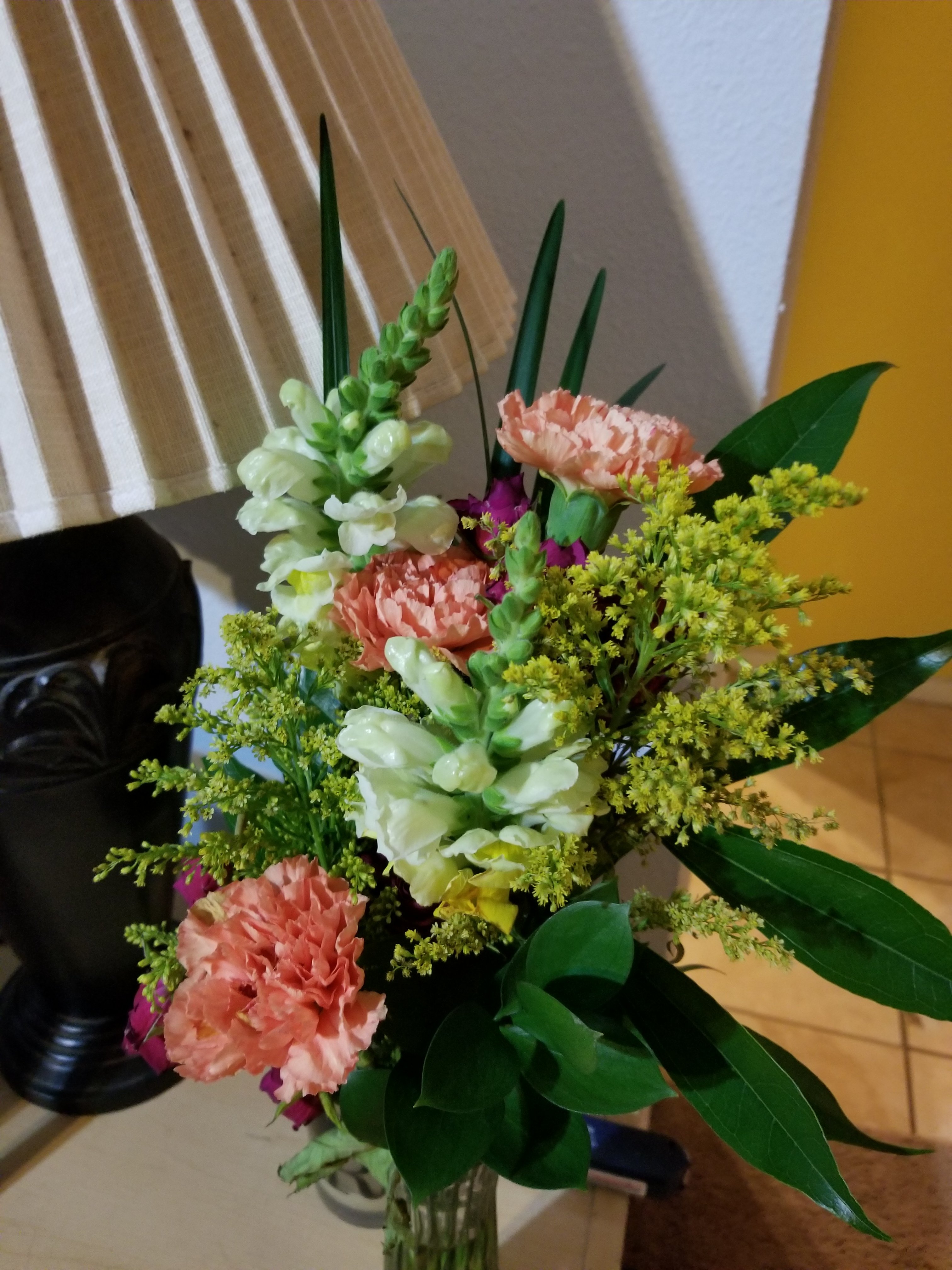
On Wednesday, Marc came home with a bouquet of flowers to show that he appreciates me. That night, we made an effort to acknowledge each others’ efforts in our relationship and reflect on what we could improve on. It was lovely to feel seen and heard.

In academia, we often must work alongside other academics for periods of time, be they through the long years of the PhD program as your committee members become the gatekeepers of your entire career, or through shorter collaborative research projects. These are all professional relationships, but when you throw something as personal as a chronic illness in the mix, it’s hard to find where the boundaries are.

Clearly, I want to communicate with my supervisors and collaborators that any delays or changes of plans are not due to a personal failing, but are because of an illness I am still trying to grapple with. However, I also acknowledge that they don’t need to be privy to the whirlwind of doctor appointments, new medications and their attending side effects, days of fatigue where even getting out of bed feels like too much, or even days when I have the energy to do work OR to come to work, but not both.

I don’t know that I feel comfortable expressing gratitude to the academic people in my life because of their understanding and patience when it comes to my illness. I mean, should I really be grateful that they are willing to work with me for not being a perfectly healthy human being all the time? Do people experience deep gratitude when they are laid up with the flu and have to delay some things or adapt to do others? Or do they just expect that the other people will be understanding?

So instead of gratitude I want to show appreciation to my collaborators and supervisors who have worked with me in changing things around because of fibromyalgia. It still takes the form of a “thank you” but it changes me from viewing fibro as something that is getting in everyone’s way, to something that gets in my way sometimes but which can be worked with.

I appreciate my academic colleagues for working with me, I appreciate my supervisors for their flexibility, and I appreciate my collaborators for their trust that I will not let them down, even if I have to work in an unorthodox way (such as by taking advantage of insomnia.)

One thing a day: an interview and then nothing

On the morning of Wednesday October 24th, I had a meeting for an internship at a museum. I had contacted the person responsible, exchanged some emails as to what sort of internship I wanted, and was told that they were excited to meet with me to talk about a mutually beneficial arrangement.

So far so good, except this week has been particularly difficult in terms of fibro fog *.

The previous night, I had to cancel a date with Marc because I was so overwhelmingly fatigued that I could barely form sentences. I had gone to sleep early, had a fitful night, woke up with a splitting headache, and faced the prospect of an interview for a position I was genuinely excited about.

That’s one of the (many) frustrating things about fibromyalgia. It robs you of the ability to fully get excited about something, to deeply delve in what you are passionate about. 

Continue reading “One thing a day: an interview and then nothing”